Last week we showed you some very well researched watercolours of Galway painted in the late 1830s by William Evans of Eton. He had made many careful studies of the types and colours of the clothing worn by native Galwegians, especially the women; of the different types of baskets they wove; the traditional everyday tools and equipment they used such as sleáns, milk churns, cooking pots and spinning wheels; the types of traditional boats they sailed.
We have two very different types of illustrations for you this week, both from the latter half of the 19th century and both drawings. The first of these, by John Leech (1817-1864 ), is a cartoon of the Claddagh, though obviously he was never there. I would say that the only type of research done was a local Claddagh person trying to describe what the village was like. There was no arrangement of cottages like those in the image to be seen in the Claddagh; the only time a gang of Claddagh women might meet like this would have been was at the Fishmarket, not in the village; there are young boys playing on upturned boats, the only types of such boats in this area would have been currachs and there is no way boys would have played on them; there are elements of caricature and even satire evident in this image such as the old lady in the patched up shawl been given a drink from a kettle, or the young boy chasing the pig in the foreground.
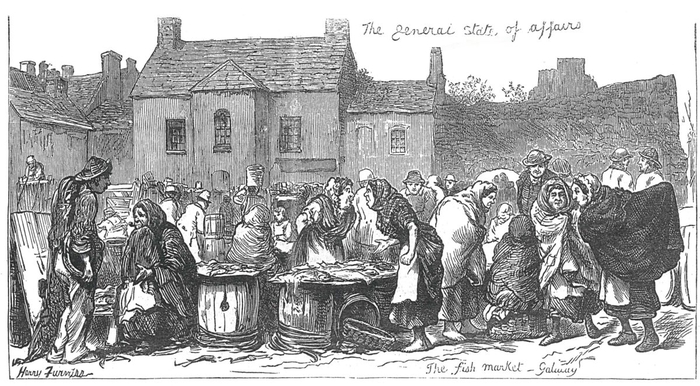
Our second illustration is a drawing of the Fishmarket by Harry Furniss (1854-1925 ). He was born in Wexford to a Scottish mother and an English father. We know from the shape of the buildings in the background that he was at least in the Fishmarket, but again, he may have descended into caricature and satire. For instance, the two fishwives arguing in the centre of the picture, if they were selling fish, would have been wearing shawls. The lady on the far right with the apparent hump on her back was in fact carrying a basket or a creel on her back which held some of the product she brought to market, such as country butter or freshly laid eggs, all covered over with a shawl or blanket. It is a cartoon but it gives one an idea of the hustle and bustle of the regular fish market that used to take place here.
These cartoons are relatively benign compared to the standards of what might be termed a ‘cartoon war’ between Britain and Ireland as the nineteenth century proceeded. The British artists painted the Irish (usually a peasant ) as more simian-like or more like a monkey and in an increasingly more insulting and degrading fashion. This applied in particular to images of Fenians or Republican Irish Nationalists who appeared increasingly as bestial creatures. The Irish response came in the form of a uniquely Irish phenomenon, a weekly colour supplement to the newspaper with no parallel in the British press. Irish artists mostly drew the Englishman (often a landlord or farmer and usually fat ) as a fairly normal figure, but the power of their message was usually in the caption. They also introduced the golden age of graphic images of Erin in the shape of a beautiful young and virtuous epitome of Ireland, an image that really belongs to the last quarter of the nineteenth century.
Finally, a note to let you know that the U3A (look them up under U3AGalway.com ) will launch their third year of activities at 11am on September 14 in the University’s ILAS centre in Dangan. U3A is open to all Galwegians over 55 who wish to keep actively learning.