There where the course is,
Delight makes all of the one mind,
The riders upon the galloping horses,
The crowd that closes in behind.
So go the opening lines of the poem At Galway Races, composed by WB Yeats in 1908, in response to a changing Ireland.
As Yeats set pen to paper, the pillars of Anglo-Irish rule were crumbling, and a new vision of Irish nationhood had begun to take shape. Faced with an uncertain future, the great poet looked to Ireland’s past, lamenting the loss of Ireland’s ancient bardic tradition and the aristocratic patronage that had made it possible.
Yeats, a passionate cultural nationalist, looked to the famous summer race meeting at Ballybrit to express what he desired to accomplish through the arts: a unity of culture. Regardless of creed, class or political inclination, the irresistible power of horse racing brought people together.
Yeats’s verse echoed the sentiment of ‘The Galway Races’, a nineteenth-century ballad later made famous by The Dubliners. Riding out through Galway town, the song’s protagonist met a crowd of ‘half a million people … of all denominations’, who shared ‘no animosity, no matter what persuasion.’ People instead travelled to Galway to spin ‘the sporting wheel of fortune’ and revel in the entertainments provided by musicians and dancers.
While the unknown author of ‘The Galway Races’ recognised the unifying power of sport and culture, they also understood the more prosaic foundations of Galway’s quick success: Ireland’s expanding rail network.
The Midland Great Western Railway company extended its line to Galway in 1851 and, eighteen years later, in August 1869, a fleet of special trains travelled westward, carrying horses and people from every corner of the island to the inaugural meeting at Ballybrit. Among the hordes of people descending on the town were ‘passengers from Limerick, and passengers from Nenagh … the boys of Connemara, and the Clare unmarried maiden.’
Many of those who made the journey to Galway were accommodated in a makeshift campsite on Eyre Square. The Connaught Telegraph reported how ‘the streets were crowded with people anxious to participate in the pleasures of an event, the like of which they never had an opportunity of witnessing there before.’
The Galway Races soon became a fixture on the Irish social calendar, with locals whitewashing their houses, and many visitors planning their holidays around it.
But what about the racing?
There were eight races on the card for the inaugural meeting, with approximately 40,000 people in attendance across two days. The architect of this great occasion was Galway’s new Member of Parliament, Viscount William St Lawrence.
The main attraction was the 100 sovereign Galway Plate (worth more than €10,000 in today’s money ), which was run over two-and-a-half miles. Thirteen horses started, and the race was ‘beautifully contested’ before being won by the mare, Absentee.
From the beginning, the standard of racing at Galway was high. In 1875, the “hard-riding, hell-raising” Garry Moore won the Plate on Liberator, a horse trained by his father, John Hubert. The father and son won the Aintree Grand National with the same horse in 1879. Tipperary Boy was the star attraction at the turn of the twentieth century, achieving a yet unequalled treble in the Plate.
The Galway Hurdle was added to the race programme in 1913, when it was won by Red Damsel.
Many of Ireland’s greatest trainers have enjoyed success at Galway, including Vincent O’Brien (who was less successful here than his brother, Phonsie ), Paddy Sleator, Aidan O’Brien, Gordon Elliott and Willie Mullins.
The ‘King of Ballybrit’, however, is Dermot Weld, who has been crowned leading trainer at the festival on thirty occasions, saddling over 500 winners here. The greatest of Weld’s winners was Ansar, appearing in Galway a dozen times between 1999 and 2008, winning a remarkable seven races: three chases, three hurdles and one flat race. This included a Plate and Hurdle double, a feat not been achieved since the 1950s.
In the 157 years since its inception, the Galway Races has transformed in scale and scope.
This has been a gradual evolution, with the initial two-day meeting increased to three days in 1959, and expanding to six days by 1982. This was partly a result of greater State investment in racing, and a growth in commercial sponsorship from the 1960s; including Guinness’ sponsorship of the Galway Hurdle, which began in 1965 and still endures.
After the difficult 1980s, Ireland welcomed the first roar of the Celtic Tiger in the mid-1990s. Ireland’s newfound affluence was evident at Galway, with unprecedented crowds flocking to Ballybrit, and with Ladies’ Day becoming one of the social events of the year.
In 1999, the Millennium Stand replaced the old Corrib Stand, and the Galway Races became a seven-day meeting. Further investment resulted in the opening of the Killanin Stand in 2007.
By then, however, the warning signs of an economic bubble, fuelled by an unsustainable property market, were flashing red. The 2008 economic crash had an immediate impact on the meeting, with attendances and Tote revenue declining that year – a situation not helped by bad weather and by the meeting’s popular association with Fianna Fáil’s annual festival fundraiser, the ‘Galway Tent’, which became a byword for speculation and greed.
The famous summer meeting at Galway bounced back quickly, however, and has gone from strength to strength in recent years. Its continued success is a testament to the racecourse staff who provide a special experience to thousands of racegoers every year.
It is also proof of the power of horse racing to enrapture and enthral; to bring people together.
Irish society may have changed almost beyond recognition since the gates to Ballybrit swung open for the first time 157 years ago, but the Irish people’s affinity for horses, and their passion for the sport they make possible, endures.
Year after year, the crowds keep on coming to the Galway Races. There, they see the riders upon galloping horses and delight makes them all of the one mind.
Frances Nolan is an author and Fellow of UCD’s School of History. Her grandfather was foreman at Fairyhouse, and her grandmother worked for legendary trainer, Dan Moore. She learned to ride in Geraghtys’ yard – the birthplace of the great Golden Miller – in Pelletstown, Co Meath.
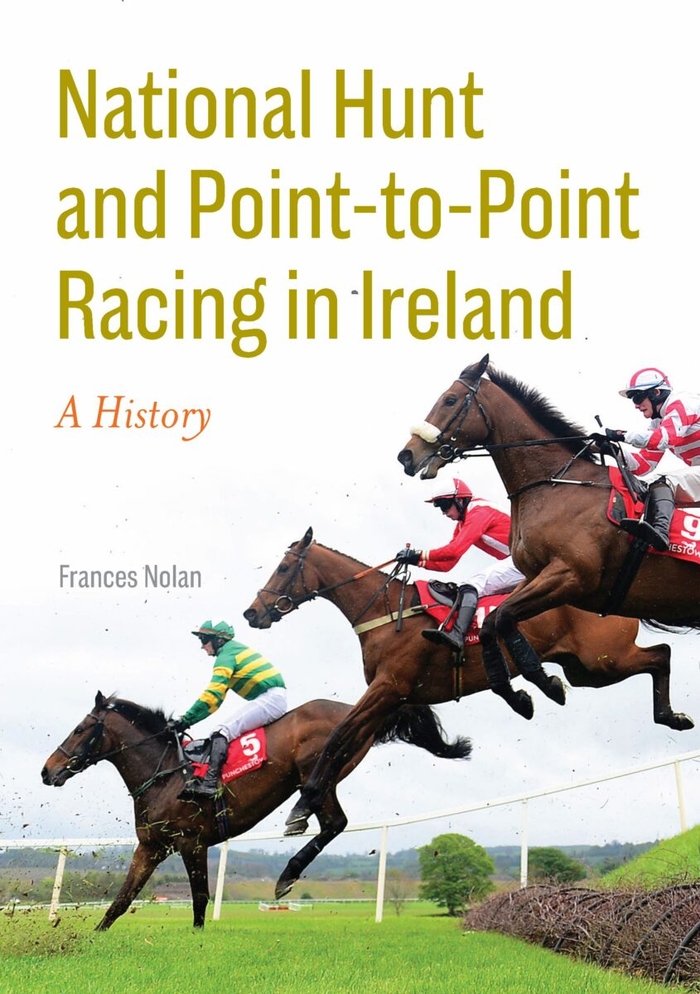
National Hunt and Point-to-Point Racing in Ireland: A History is available now from Four Courts Press.