Salthill Park was originally a large field with a small lake. It was landscaped in 1907, but a cesspool developed there. The newly formed Salthill Development Organisation asked the Urban District Council to clean it up, and eventually, after some years, they did.
In the meantime, the British had left Ireland after the Treaty was signed. The Royal Air Force had an airfield in Oranmore, which included an aeroplane hangar. The Urban Council decided to buy this construction (against the advice of most of their members ) and have it transferred to Salthill Park. The total cost was just over £2,000. It turned out to be an outstanding investment for the council as it repaid them some £70,000 to £80,000 over the next half-century.
They decided a ‘dancing floor’ in timber would be laid down, and this quickly became known as one of the best sprung dance floors in the country. It opened as The Pavilion Ballroom, as you can see from our photograph, but it quickly became known simply as The Hangar. Thomas O’Toole was the first to lease it.
The Salthill Development Group later took over the lease. They paid the rent and also gave all the profits to the council on condition that they use the money for the development of Salthill. They wanted to create a strand, erect a breakwater pier and provide proper bathing facilities in the area.
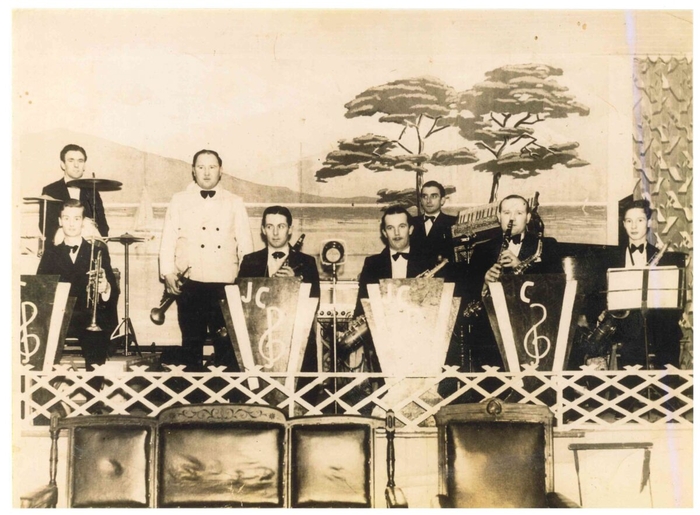
The resident band at the time was run by Johnny Cox. Our 1946 photograph of them (below ) shows, back row: Dan Burroughs on drums, and Paddy Tier on piano. In front are Billy Davies, trumpet; Johnny Cox, trumpet; Vic Burgoyne, clarinet; Johnny Burke, saxophone; Jimmy Cox, clarinet; and Ernie Reynolds, saxophone. They made up their own songs …. Come and listen to the band / and you will help improve the strand. Tread the light fantastic here / and you will make the foreshore clear. Dancing feet can lend a hand / to treat us to a fine strand. Dancing at the Salthill Pavilion / can make the foreshore look a million. Every half crown at the door / is a rock off the shore. Dance with Cox / and remove the rocks.
Sunday night was céilí night: “We had to have a rack built outside to hold 400 bikes, but there was not just enough room. It was a hell of a sight to see a sea of bikes making its way out after dances.” The céilí phase later became a “semi-céilí and Country & Western” phase which, in turn, gave way to a “Country & Irish phase”.
The biggest crowd ever there, of some 2,500 people, came to see Bridie Gallagher. The Clipper Carlton were probably the first ever showband to play there and they were followed by hundreds of others. When the SDO gave up the lease, it was taken over by local businessman Tommy Nevin.
An agent in London offered Tommy some international artists including Chubby Checker, the inventor of ‘The Twist’ (who cost £150 ); The Batchelors (£125 ); Hank Loughlin; Adam Faith; Jim Reeves; Johnny Cash; Bill Haley; Rory Gallagher; Thin Lizzie; and Horslips. Donovan was very big at the time and he toured with a newly formed group named Planxty who came on first and were such a big hit, the crowd did not want them to stop.
Tommy had also booked an un-heard of new English pop group called The Beatles, for £85. Between the date of booking and the date they were to play, their first single ‘Love Me Do’ came out and was a smash hit. Their manager called Tommy and asked, “On your best night, how much money would you make?” Tommy said £500 and so Brian Epstein sent him a cheque for that amount and The Beatles never got to play the Hangar. Ah well, their loss.
In 1974, the Hangar closed down. It was bought by Paddy Dempsey from Craughwell who hoped to use it as a venue in which to train his horses.
Ballrooms were going out of fashion at the time as discos and night clubs were beginning to take over but many will still remember The Hangar with great affection and nostalgia… How many romances started there? How many marriages resulted? And just think, if that building could talk, how may dance styles did it experience? The Old Time Waltz, the Fox-Trot, the Charleston, the Black Bottom, the Siege of Ennis, the Twist, the Mashed Potato, the Jive and Rock … It is a wonder the half-inch thick maple floor survived at all.