Nicholas Arthur Colohan was born in Enniskillen on August 12th 1884 to Nicholas Whistler and Lizzie Colohan. The family moved to The Villa opposite the Crescent in Galway. He may have been tutored at home as his family were reasonably wealthy. There are no records of him attending either the Presentation or the Jesuit primary schools. The earliest record of him in education relates to his first year in secondary education in the Bish. As a pupil, he was far from impressive and this prompted his parents to send him to Mungret College Limerick as a boarder and there he finished his secondary education.
In 1900, he was barely sixteen when he was registered as a matriculated student at the Royal University of Ireland and he embarked on an Arts course in UCD. He passed First Arts in Summer 1904 (having received private tuition ) and four years later he passed his first exam in medicine, also in UCD. In 1910, he was exempted from further exams in Practical Chemistry and he transferred to UCG. He was described as a “chronic” rather than a “serious” student, and when he finally graduated in 1913, his fellow students said of him “The Young Cock has crowed at last”.
He was a member of the Literary and Debating society and he also took part in many college drama productions, he loved hunting and fishing but most of all, he loved music and playing the piano. Professor M.D. O’Sullivan, a contemporary, once said of him; “Arthur could scarcely be described as the model medical student. We prefer to remember him sitting at the piano, strumming out tunes.” It could be said that his carefree nature and sociability were factors in prolonging his student days.
He composed a number of songs including “Macushla Mine”, ‘Asthoreen Bawn’. “Until God’s Day”, ‘The Kylemore Pass’, “The Claddagh Ring” and of course “Galway Bay” which for some time was the biggest selling record in the world. It has been said he wrote it in memory of his brother who drowned somewhere off Seapoint.
There are several theories as to where the song was written or where it was first heard. Some say it was in the home of Dr. Morris who lived at The Ivies, No.1, Montpellier Terrace, some say that it was in the Vicar’s Croft on Taylor’s Hill, some say that he wrote it in his home in Leicester in England.
Professor Tom Dillon, also a contemporary, used to describe Colohan telling a group of fellow students in the Western Hotel on Prospect Hill that he had written a song and how he sat at the piano and played it for them. Some laughed, some were a bit derisory butt others realised that there was real talent there. Christy Townley remembered it being sung by Kevin Hilton in the old Empire Theatre off William Street`, and some other Galway singers began to include it in their repertoire.
Arthur began his medical career in the County Infirmary on Prospect Hill and then moved to Holles Street in Dublin. He was badly affected by mustard gas while in India. After the war, he settled in Leicester where he spent the rest of his career as a neurological specialist. He married Maisie Curley, a Galwegian like himself but the marriage did not last, It was believed that the after-effects of the war on him were the real cause of the break-up. They had no children.
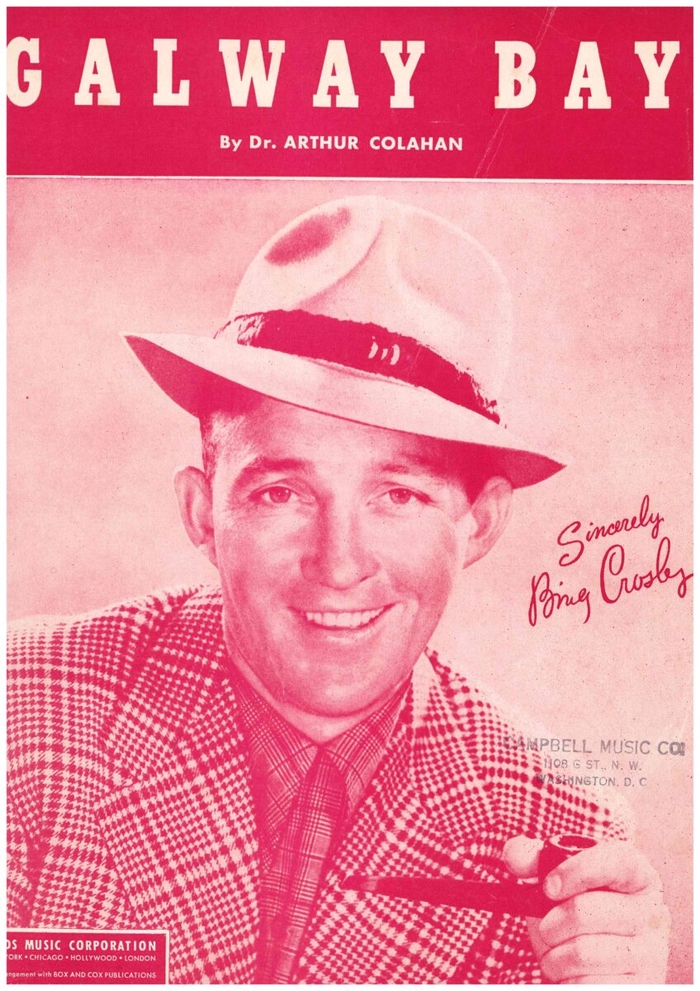
He came home several times and would regularly gather around a piano with his family and friends and sing old Irish songs together. Sometimes, he would tell them “There’s a song in my head”. and on one of those visits, a music promoter overheard him singing “Galway Bay” and arranged to publish the music, and so the song became the best-selling popular song in Britain in 1950. It was recorded many times by different artists, most notably by Bing Crosby whose rendering of the song made it enormously popular in America.
Arthur apparently composed a lot but rarely wrote anything down, preferring to rely on his phenomenal memory and as a tuneful wordsmith, he would indulge himself in his free time in weaving patterns of beauty in words and phrases.
He died on the 15th of September 1952 in Leicester and three days later was buried in the New Cemetery in Bohermore. Our photograph shows Arthur in is college robes, our second is of the cover of his most famous song.