The Athy family is of great antiquity in Galway. According to Hardiman they were “From the earliest times highly respectable." They are descended from Gerard de Athee who was born in France at Athee sur Cher. He was a well-known knight and military leader for Richard the Lionheart, King of England.
The Athys were originally Anglo-Norman, but on coming here, they quickly assimilated and became one of the 14 Tribes of Galway as their surname changed from Athee to Athy. Their estates were mainly in the Oranmore area, they owned the Rinville Estate. They are credited with being the first family to erect a stone house or castle in the city in the 11th century. The number of castles associated with the family through the years show just how influential they were — Ballylee, Carrigin, Glinsk, Castletown, Rinville, Claregalway, Ardmullivan, De Bermingham’s, Aughanure and Castledaly.
The family became involved in a deadly feud c1320 with the Blakes, and the Athys came out worst, possibly because the Blakes were regarded as ‘positive’ while the Athys were ‘jealous’. A member of the family, Margaret Athy, founded the Augustinian Monastery on Forthill in 1508.
One of the family buildings was on St Augustine Street, just to the left of Mayoralty House. Nobody is certain if it was the first stone house built in the city. We have two images of the doorway, the first a detailed drawing published in 1845, the second a photograph taken by Professor Michael Duignan roughly 100 years later.
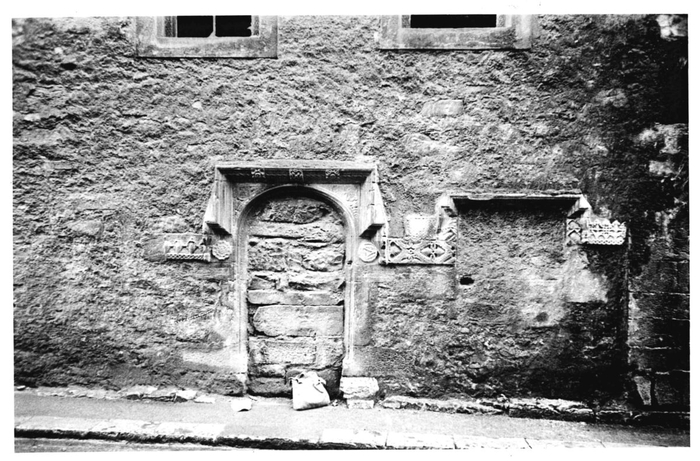
It was described as “Perhaps the loveliest fragment of 16th century urban domestic architecture in the whole of Ireland”. The details of the doorway are characteristic of the period in Ireland in combining late Gothic forms with classical mouldings — ovolos and cymas — and Celtic interlacements. The conventionalised vine leaf of the lozenge and squared form also plays a large part in the ornament. In the right-hand spandrel of the door arch is a small shield bearing the date 1577, while a coat of arms – a chevron over a grille of some kind – is the principal ornament of the other spandrel. The jamb stones are decorated with panels of plain punching. The arms were clearly intended for Athy.
The doorway was saved from demolition when purchased by the sculptress Clare Sheridan for the sum of five pounds. She had it removed on the first week of December, 1947 and had it placed in her small garden at the top of the Spanish Arch. Some people, including Richard Hayward in his book Connacht and the City of Galway objected, saying that no private purchaser should be allowed to buy such a civic treasure, especially as these precious fragments belonged to a building, which, at the time of their removal, was still capable of being restored and which would have made a splendid and much needed Old Galway Museum.
Whatever one thinks of Clare Sheridan’s actions, the fact is that she preserved these beautifully carved stone fragments for posterity, and ironically, they featured for many years as part of the exhibitions in the old Galway City Museum in Comerford House.
They are currently kept in storage by Galway City Council. Many years later, Jimmy Lydon would buy up a lot of carved stones that decorated buildings in the city which were about to be demolished, and display these in his Shop Street restaurant. They are now, happily, preserved in Galway City Museum.
On the 1651 map of the city, one of the highest tower houses in the city, behind Market Street and opposite the Collegiate Church, was an Athy house. In 1879, the family owned over 1,400 acres in the county. Today, the Athy name has all but disappeared from Galway.
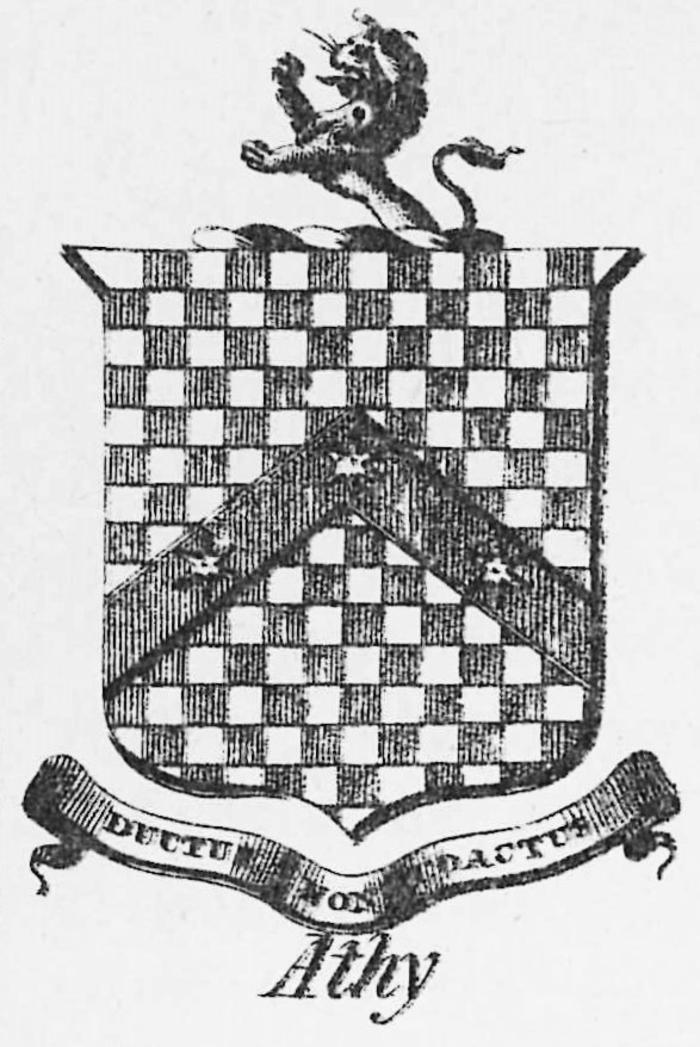
The Athy coat of arms (illustrated ) is described as “Checky, argents and gules, on a chevron of the last, three etoiles, or. Crest, a demi lion rampant. Their motto was Ductus non Coactus.