The traditional Galway farmers’ market is mentioned in records as far back as 1260. It has been taking place in the empty space in front of St Nicholas’ Collegiate Church on most Saturdays since. It is an occasion where town meets country, as farming people from the hinterland come into town with their produce, which is of course important for the needs of the townspeople.
The introduction of the Penal Laws prohibited Catholics from opening a shop or operating as a street trader. The only exception to this was on market days when they were allowed sell their goods. The market became the only means of survival for many during these times. During the Great Famine, the market was empty of produce, and any good potatoes were being securely stored, making a bad situation worse and resulting in attacks on potato stores and riots on the streets
As the market progressed towards the end of the 19th century, many people from the countryside had become dependent on this famer’s market, an outlet that had a variety of produce on sale — potatoes, vegetables, live fowl, eggs, country butter, buttermilk, dillisk. Most of these goods were sold from the back of a donkey and cart, their normal mode of transport. It was a long day for these people, starting out from their homes at dawn, sometimes earlier, in order to be in the market by early morning and have a good space. It would be a long time before they got home, often after a cold and damp journey over rough roads. Some of the women walked to town, often barefoot, carrying large baskets of eggs or butter and would have to walk miles home afterward.
A number of public houses in the vicinity of the market had early morning ‘market licences’ to sell hot drinks, food and alcohol to farmers wo had travelled a long way. Occasional locals, ‘on their way home’ often availed of these early openings.
September 16, 1961 was a particularly bad day at the market. Most stallholders had already brought their goods on site when Hurricane Debbie hit the city. Most of the produce was lost in the gale as stalls were blown over and some ended up streets away. People and traders had to take refuge in St Nicholas’ and in nearby buildings and pubs.
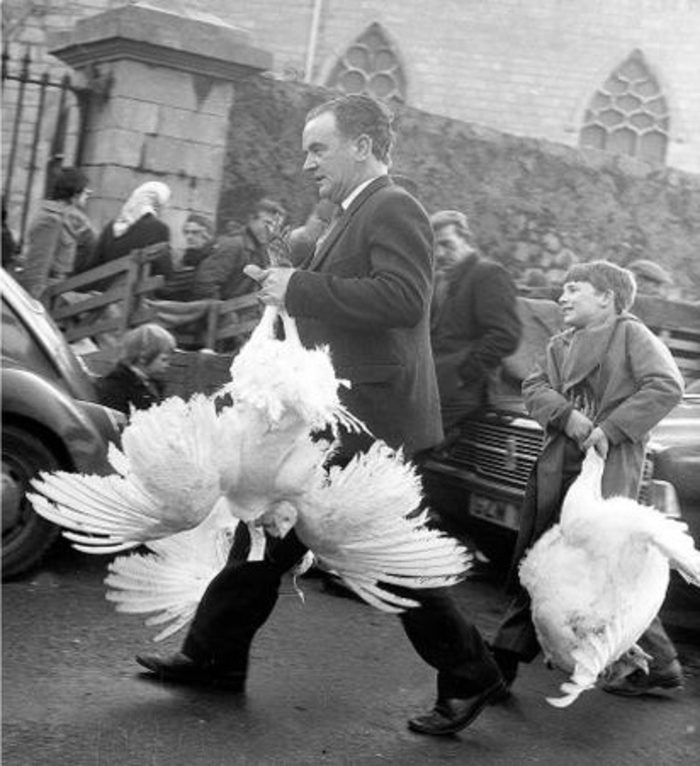
The Christmas markets were different in character with live geese and ducks on sale, and later turkeys. Customers could also buy Christmas trees and holly. Adults or children carrying live geese was a regular sight across the city. Some would carry the live goose or turkey on the crossbar of the bicycle. Sometimes, these birds were hung on the railings of the church and occasionally, they would be taken around the back of a cart or a van to have their necks wrung. Most people had to kill and pluck their own purchase to make it ready for cooking.
Our photographs today illustrate some of the different ways customers carried their Christmas dinner home; image A shows Tom Dodd from Bohermore carrying two heavy birds on his shoulder in 1964; Image B has a man carrying two turkeys in the usual fashion, by the legs. It was taken in 1967. Our third photograph was taken from the upper floor of a building in Market Street in 1964 and shows a typical cart with turkeys on board. The large tarpaulin may be covering more birds. Two women are seen on the street holding a turkey by the neck in 1964.
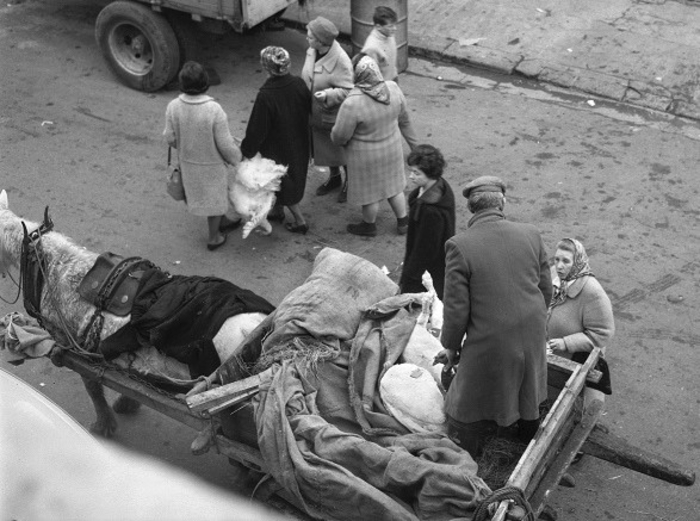
These images are among a long list of illustrations, as is the above information, from a new, just published, book by William Henry entitled The Galway Market, An Old Tradition. It tracks the origins of the market and how it changed and evolved through history and right up to the present. Many of the characters, past and present, associated with this long running event, are represented as are the present stall holders. This book is a charming entertaining portrait of an old Galway tradition and is available at €20 in good bookshops. An ideal Christmas gift for a Galwegian.