On this day, October 23, 1928, Coláiste Éinde (St Enda’s College ) opened in an old house belonging to the Blake family in Furbo. It had been founded by the State shortly after the State itself was founded. The aim of the college was to teach boys through the medium of Irish so that they could go on to third level at St Patrick’s Training College, get a secure job as an Irish language teacher and then, in turn, educate a new generation of boys as Gaeilge. The college did not last very long in Furbo as there was some kind of domestic dispute between members of the Blake family and the school had to be evacuated by Christmas 1930, so they moved it to Dublin, to Talbot House on Talbot Street.
From the beginning, it was a residential second level college. One had to pass a testing entrance exam, with the emphasis on oral Irish, to gain admission. It was a Scoil Lán-Ghaelach. The first class had 29 pupils. The second group of scholars arrived in the school year 1931/32 and two years later, the college moved to a premises in Glasnevin. In the meantime, the Government had a plan to build a preparatory college on Threadneedle Road for nuns who were hoping to become principals and teachers in national schools. Construction began in 1928 but when Bishop O’Doherty realised that a new order of nuns were coming into the diocese, he stopped the building works. The skeleton of the edifice was left for a number of years but eventually the Government finished the building on a smaller scale than had been planned and Coláiste Éinde formally opened on October 10, 1937.
The construction work was finished by Stewarts who had 150 men working there, no lifts, no cranes, just a few concrete mixers and men carrying buckets. The total cost of construction was £85,394.
It was a second-level preparatory boarding school until 1961, when it opened up to the usual wide spectrum of students, many of them day pupils. In 1986, it changed to a day school and in 1992, it became co-educational.
On the first day of the war a liner, The Athenia was sunk off the west coast and several hundred survivors were taken into Galway. More than 100 of these were offered refuge at St Enda’s. School holidays were extended while sailors from the ship took over the kitchens. The Irish Army occupied the east wing of the school as a military hospital from June 9, 1943 and they treated wounded soldiers from Italy and Germany. A red cross was painted on the roof (barely visible in our image ) and the school was temporarily moved to Dublin.
This aerial photograph taken c1950 shows just how extensive the building was, even if it was on a smaller scale than originally intended. The large field surrounded by a path, seen at the top of picture, was the playing pitch.
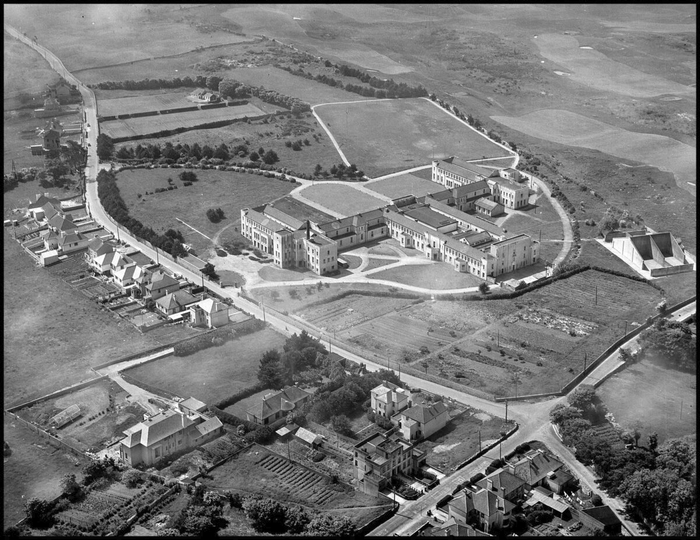
Bóthar na Mine, ‘The Road of the Flour’ which somehow translated into Threadneedle Road, was a Famine relief project. The house on the corner at the top of that road was Murphy’s, Glynns were next door and then Langan’s. The next house, in off the road, was Professor Dunican’s and the large house bottom left of picture was McConn’s; the laneway into it was known as McConn’s Lane. Going down the hill, the next house was Professor Folan’s, then Lydon’s which later became Seán Ó Beirne’s; O’Halloran’s who had a shop there; then Barry’s. Next door was a bungalow, then Condon’s bungalow; then Kerr’s and Malachy Burke’s. Then there was a gap; McNamara’s; Sugrue’s house; and Dempsey’s. What we know today as Dr Mannix Road was a path which led into the back of Boland’s house, now the Ardilaun Hotel. It was a kind of Lover’s Lane and was known locally as ‘The Chariot’. The house on the far side of the gap was Cunningham’s (who moved there from Loch Lurgan guest house in Salthill ); then the Anno Santo (Vaughan’s ); Niland’s; Murphy’s and Craughwell’s.
The building you see in the distance on the right was the Tennis Club. To the right of that again was part of the Golf Club. The handball alleys were very good ones, much used by the pupils and also by players who came out from ‘town’. The field between the alleys and Threadneedle Road was cultivated by the school where they grew their own vegetables, potatoes etc. Today it is a small housing estate aptly called The Gardens.
The house at the corner of the top of Taylor’s Hill and Cloran’s Road (bottom right of our picture ) was Geraghty’s. Beside them were Cradocks; then Superintendent McManus; Wyers; Ó hUiginn’s; Caulfields and Emersons.
This image was taken by Norman Ashe, a Dublin photographer who specialised in aerial photography. It is one of a series of negatives of his that were recently discovered by Patrick Kiersey and he has generously put them all online. If you google Norman Ashe Photography, you will find extraordinary images from many parts of the country and the site is well worth a visit. So thank you Patrick Kiersey for permission to publish this picture today.
Our thanks to Enda Folan for his help with the above.