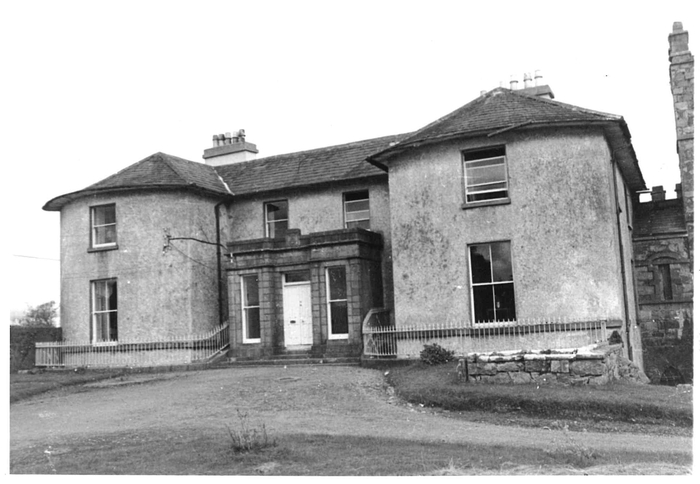
On this day, June 26, one hundred years ago, the Sisters of Jesus and Mary bought Spires House in Shantalla. Three of the sisters in the order had come to UCG the previous year to study for a degree and while they were in Galway, Mother Stanislaus looked for a suitable premises for a house of studies for them and finally purchased this premises. The house dates from the 1840s and got its name from the two unusual spires you can see on the roof. The building was used by the sisters as a hostel for secular students as well as their own nuns and these nuns became known locally as ‘The Spires Nuns’.
The newspaper known as the Galway Mercury recorded the birth of a son to ‘the lady of John S. Kirwan of Spires House' in 1845. It was later occupied by a Presbyterian minister, the Reverend John Courtney Clarke from 1882 to 1917 and later again, the Young family lived there until 1925. “It was even larger than the picture shows. The front wing on the left had a small yard behind it and beyond that, a wing with two storeys, kitchen, scullery with a nursey and bedroom on top. Another wing ran along the side on the road to the right, with two bedrooms on top and five storerooms or pantries. With all the yard space beyond the wall and two gardens, it was a wonderful family house and a memorable one for us all,” according to Mrs Marion Cayton, a descendant of the Youngs.
The Sisters of Jesus and Mary later added on to this building. They built two storeys on to the section we see on the left and they moved the left spire to the new gable end of the building turning it into a fifteen-bed ten-bathroom detached house. They also had a grotto in the garden.
The sisters later acquired Fort Eyre, the building at the end of the terrace behind this house. Fort Eyre was built by a Cromwellian officer named James Eyre. When he died, he had no heir but he did have a number of illegitimate children named Maunsell. These people inherited the house which dates to 1780 and in 1822, built it up to what it is today. The road became known as Maunsells Road. The house stayed in the family’s possession until about 1890 when the British Army took it over and used it to house officers. They had a lot of stables there. The Maunsell family regained possession about 1920 and there is a Maunsell coat of arms over the door.
The main house was subdivided in the 1920s into Fort Eyre and Hansberry House which comprises the north-eastern part of the building that fronts on to Shantalla Road. Seán Mac Giollarnáith lived in Fort Eyre with his wife, Theresa Ferran-MacGiollarnáth and their three sons Frank. Colm and Seán. Professor Eoin McKenna and his daughter, the famous actress Siobhán - who has written very warmly about her teenage years in Shantalla - lived in Hansberry House. There is a folly on the grounds of Fort Eyre known as ‘The Penny Tower’. It was one of those relief works built around the time of the Famine for which the labourers were paid a penny a day, hence the name. It was probably intended as a clock tower as there are clock faces on it. There is a plaque to the rear of the tower bearing the inscription ‘Fort Eyre, 1922’.
Fort Eyre was vacant from 1969 to 1973 when it was bought by Mr and Mrs Smith who lived in one of the three flats in the main building. They were given planning permission to substantially develop the site in 2003 which allowed them to do some work on the Penny Tower.
Between Spires House and Fort Eyre was a two storey terrace comprising of numbers 56, 57, 58 and 59, Shantalla Road, buildings which attest to the late 18th/early 19th century developments in Galway. The most interesting building is Number 57 due to its visible architectural attributes; it is a fine example of a small Georgian house. The two limestone jostle stones at the front of that building mean that it is a protected structure. Going back to the nineties, the street was a bustling urban centre with James Davoren’s butcher shop, a corner shop, a fast food outlet, a bakery and a video shop.
Our thanks to Anne Carey for her help with this article.