The place-name Shantalla is derived from the Irish ‘Sean Talamh’ meaning old ground, though why Shantalla should be older than the ground around it is a mystery. Maybe a lot of it was never worked and left wild. Sometimes the name was written as Shantallow, and locally it was always known as ‘Shantla’.
Rahoon Road was the main thoroughfare, the way most farmers from the Rahoon area would make their way into town for the fairs and markets. Apart from that, the landscape was divided by stone walls into small fields and was populated by occasional scattered houses.
On June 25, 1843, it was estimated that some 300,000 people came to a monster rally organised by and addressed by The Liberator, Daniel O’Connell. It happened on the estate of Thomas Bodkin who gave permission for the event to take place on his land. The location where he spoke was called ‘Emancipation Rock’ and would later be known to generations of local children as ‘The Sliding Rock’.
At the end of the 19th century, a Scotsman named Miller rented the Fisheries on the river, and in order to find work for his men during the winter months, he employed them quarrying and polishing local marble. They noticed some red stones which abounded on the surface of Col Courtenay’s property in the Maunsells Road area and when some of these were wrought and polished, it was discovered that the material was valuable. So, leave was taken to work these granites in 1880. Miller employed 20 men and established a small industry in the middle of this agricultural landscape.
In 1900, The Galway Granite and Marble Works was formed and in 1911, they spent £2,000 on the construction of a one and a half mile branch railway line along what is now Seamus Quirke Road which linked with the Galway-Clifden Railway Line and enabled them to carry stone into the station for transfer to their works just opposite the Old Gaol.
In the late 1940s, Galway Corporation devised a plan to construct the housing complex we know as Shantalla today. The site was four and a half acres facing a new road developed near the old road, known as Red Lane. The proposed houses would contain a living room, three bedrooms a lavatory and a scullery. The external appearances would very between terraced houses, estimated to cost £350 0s 1d per house, and gable end houses, estimated cost £379 20d per house. The Corporation also took over a number of unfinished buildings known as ‘the Bermingham Houses’ as part of the scheme. Today they are called Shantalla Place. The plan was to clear some of the tenements in town and transfer the people to Shantalla. This caused some distress to some of the ‘townies’ who were very nervous of moving, less than a mile, ‘out the country’.
Our first photograph today shows the Shantalla Residents’ Association committee of 1970/71. They are, back row: Michael Lynch, Davis Road; Fintan Coogan, Mayor of Galway; Tom Furey, Colmcille Road; Mr Farrell, Davis Road; Pat McDonagh, O’Flaherty Road; Tom Murray, O’Conaire Road; John Robinson, Colmcille Road; Mick Connelly, Davis Road; Nora Crowley, McDara Road; Jack Geary, Costelloe Road; Bill Butler, O’Conaire Road; Joe Tighe, O’Flaherty Road; and Mr Scanlan, Colmcille Road. Front row; Bill Smith, O’Conaire Road; Mrs Cunningham, Fursey Road; Mrs Farrell, Davis Road; Canon Glynn, Parish Priest; Eileen Spelman, Colmcille Road; Mrs Keogh, Davis Road; and Mrs Coogan, the Mayor’s wife.
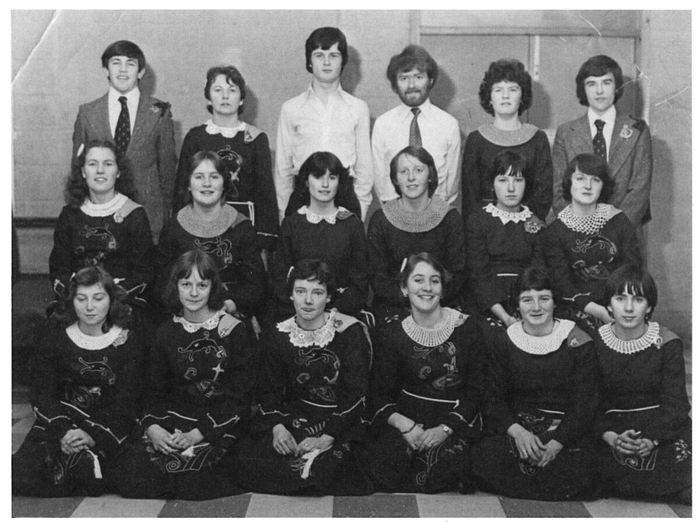
Our second image is of a group of Irish dancers from the area. They are, back row, left to right: Gearóid Brown, Peggy Joyce, John Mulcahy, Mike McHugh, Nancy Sullivan, John Kavanagh: Middle row: Julie Sullivan, Teresa Higgins, Geraldine Walsh, Regina Spellman, Annette O’Neill, Delma Kavanagh. In front are Bernie Kelly, Eilish Brown, Marie Kelly, Nonie Higgins, Martina Kelly and Helen Phelan.
All of the above are from a new book published this week entitled The Story of Shantalla: in the words of its people. It will be launched this Saturday by President Catherine Connolly in the Clybaun Hotel at 8pm. A volume of 400 pages with some 800 photographs, it is a comprehensive study of the area and its people which has been edited by Tom Nally, Anne Marie Butler and Bridie Thornton. It will retail at €30 and will be available on sale at the launch and thereafter from Tom Nally’s Barber Shop on High Street. Very highly recommended.