Search Results for 'Thomas Ashe'
4 results found.
Liam Mellows Hurling Club
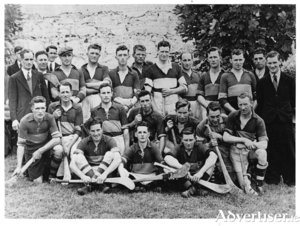
In 1791, a French writer, in his impressions of Galway wrote, “In August, hurling begins to be played. Each team is divided into three sections – 'L’arriere' of back guards the goal and seeks to stop the ball from passing through. Another group is in front to prevent the enemy’s ball from coming back from that end, that is the middle; the third group called the whip is 'sur le terrain' [on the ground]. The game of hurling is 'Behine' and the place they play – Turlough. The ball is cow’s hair, very compact and covered with leather. The spectators are on the ground about – the majority dancing. The sides are distinguished by the colour of their caps. It is terrifying to see the way they rush into each other to force the ball to pass under the goal.”
Liam Mellows, county champions
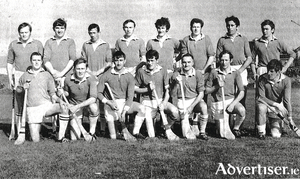
We know that hurling was played in the Bohermore area 200 years ago. Several different clubs operated around there at different times — Galway City, Bohermore 98s, College Road, Thomas Ashe, etc. Players would occasionally transfer from one club to another so it was natural for them to join the new club that was formed on February 11, 1933. The club was called Liam Mellows after the patriot who led the 1916 rebellion in Galway.
Letter from Behan among the interesting items as Conradh na Gaeilge deposit archives at NUI Galway

NUI Galway is to become custodian of the extensive archives of Conradh na Gaeilge, Ireland’s oldest Irish language organisation which celebrates its 125th anniversary next year. Conradh na Gaeilge has agreed to permanently deposit archival material spanning over a century of its existence, providing an unparalleled insight into linguistic, cultural, social and political aspects of Ireland’s past.
Concert to commemorate hunger strikes
Pat Sheehan, who went 55 days without food during the 1981 hunger strikes, and who is now Sinn Féin MLA for Belfast West, will speak in Galway this weekend, at an event commemorating the use of hunger strikes by Republicans throughout the 20th century.