Search Results for 'Sebastian Nolan'
5 results found.
Gentian Hill
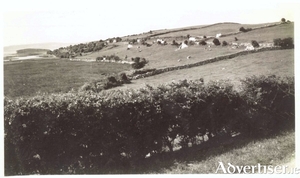
The correct name of this area is Blake’s Hill which comprises approximately 30 acres. An early Admiralty chart refers to it as Mount Blake. It is a drumlin, as is Carragh Hill, a continuation of it. Gentian Hill was a much smaller area further north but the whole area is now referred to as Gentian Hill. There is a ringfort on top of the hill which became evident from aerial photographs.
Galway Golf Club, the Barna course
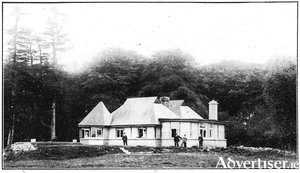
On May 9, 1905, there was a meeting held in the Royal Hotel of golfers that had been banned from membership of the Gentian Hill club by the landlord there, Sebastian Nolan. They decided to form a new club under the presidency of the Hon Robert Dillon. It was reported that on that day a committee had accompanied Larkin, the Bray professional, over a promising new course on Mr Marcus Lynch’s property at Barna and were happy about the suitability of the ground for a nine-hole links.
The first Galway golf courses
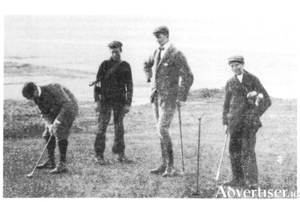
The first golf course in Galway was constructed by Lieutenant Colonel Jourdain, the last Colonel of the Connaught Rangers, on military grounds at Renmore Barracks, between the rifle range and Cromwell’s Fort, in 1893. Play was originally confined to military personnel, but then some members of the public were invited and it took off so well that the colonel and his friends were invited to lay out a course on Knocknacarra Hill.
Seamount Nursing Home
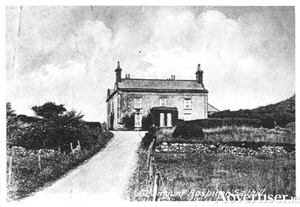
A “to let” advertisement in a Galway newspaper in April 1860 promoted the fact that Seamount Villa contained a parlour, drawing room, six bedrooms, a kitchen, water closet, a coach house with some stabling, and a small garden. The grounds were nicely laid out and had an approach to the sea. George Fallon who lived at ‘The Baths’, Salthill, would show the place to prospective customers.
Gentian Hill
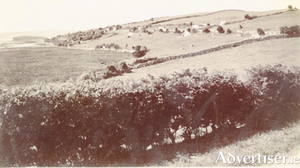
The correct name for this promontory is Blake’s Hill which comprises approximately 30 acres. Gentian Hill was a much smaller area further north, but nowadays the whole area is referred to as Gentian Hill. An extract from O’Donovan’s Letters described it as follows: “Here in Blake’s Hill over the sea, whither the young men of Galway were wont to come on horseback on the third day of their May game, and there dine between the hill and the castle of Barna. Sir Moragh O’Flaherty of Aughamore defeated an army out of Clanricard on the 22nd of June 1564 on the strand at Traybane, Cnoc an Blacaigh.”