Search Results for 'Dick Byrne'
29 results found.
Folk club reborn back the West
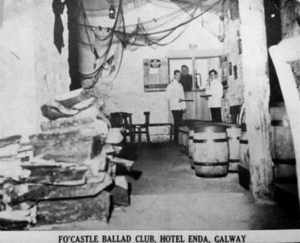
There will be two featured acts on the night, plus invited guests and a selection of local performers.
A history of Our Lady’s Boys Club
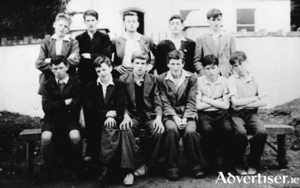
In the 1940s the seeds of great social change were sown in Ireland; Irish society began to “feel the full force of the cold blast of social change”. In 1940s Ireland, the State gave no assistance to the out-of-school education of young people. The need to provide social and recreational activities for young people was enormous. The Jesuit Community responded to this need by setting up Our Lady’s Boys Club in 1941, which began to provide organised recreational activities to the youth of Shantalla, Bohermore, Claddagh and ‘the West’.
Nostalgia for The Hangar
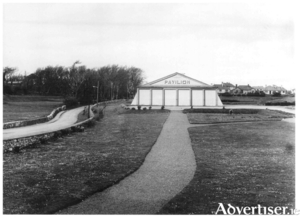
Salthill Park was originally a large field with a small lake. It was landscaped in 1907, but a cesspool developed there. The newly formed Salthill Development Organisation asked the Urban District Council to clean it up, and eventually, after some years, they did.
The Galway River, 1952
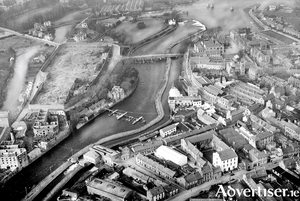
If you are in an aeroplane flying over a village or town, you get a fleeting impression of what that village looks like, but if one knows how to operate a very good camera while flying the aircraft, you might get a pin-sharp illustration of what that village looks like and how it is laid out. That is exactly what our pilot/photographer did in 1952 when he/she took this shot of the river from the Salmon Weir down to the Hygeia building.
Some Galway pipe bands
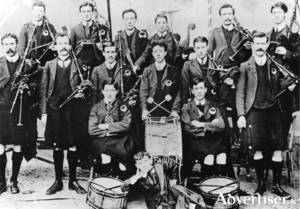
A marching pipe band is an ensemble of people playing bagpipes and drummers which requires coordination, discipline and timing. Every step should align with the band’s formation and rhythm and they should be visually and musically synchronised. They are usually led by a drum major with a mace to signal movements such as starting, stopping, wheeling etc. So we thought today to show you some of those bands who have graced our streets and entertained us over the years.
‘20th Century Boys’
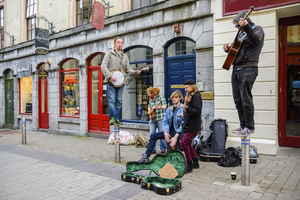
Traditional Irish music in the mid-20th century did not enjoy the revered position it now holds in Galway.
Newtownsmyth
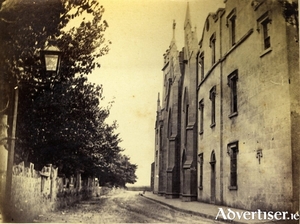
In the late 18th century, a ‘new town’ — Newtownsmyth — was built outside the town wall on the northern side. The project was undertaken by the governors of the Erasmsus Smith estate. In this suburb, a county courthouse was erected in 1815 and a town courthouse in 1824. In 1823, there were objections suggesting that there were several suitable sites ‘immediately in town’ and that it was ‘quite idle’ to lay foundations in the suburb of Newtownsmyth.
Shantalla and its people
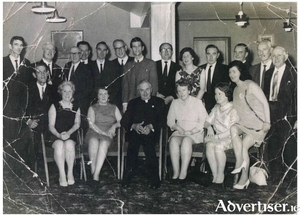
The place-name Shantalla is derived from the Irish ‘Sean Talamh’ meaning old ground, though why Shantalla should be older than the ground around it is a mystery. Maybe a lot of it was never worked and left wild. Sometimes the name was written as Shantallow, and locally it was always known as ‘Shantla’.
When motoring came to Galway
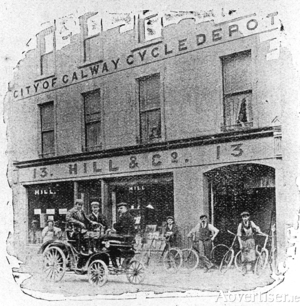
The first motor car was imported into Ireland in 1896. The early ones were steam-powered and badly suited to Ireland’s climate and roads. There was no surface on the roads, lots of potholes left by horses and animals, and of course pedestrians who were unfamiliar with motor cars. Some thought they were parts of trains that had broken off, noisy and smelly vehicles driven by faceless people – drivers wore goggles and head coverings to keep smoke from the engines and road dust from irritating their eyes and nose. Others thought they were the devil’s work and would bless themselves and say a prayer as these cars went by.
Galway Golf Club, the Barna course
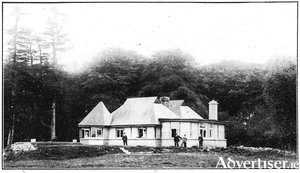
On May 9, 1905, there was a meeting held in the Royal Hotel of golfers that had been banned from membership of the Gentian Hill club by the landlord there, Sebastian Nolan. They decided to form a new club under the presidency of the Hon Robert Dillon. It was reported that on that day a committee had accompanied Larkin, the Bray professional, over a promising new course on Mr Marcus Lynch’s property at Barna and were happy about the suitability of the ground for a nine-hole links.